Saturday, January 15, 2011

Contextual Research: Garry Hume

Garry Hume
Hume is an English artist, born in Kent.  I think some of his most interesting pieces are those such as his 'Door' paintings or his series entitled 'Water' (which looks at the female form).


(example from 'Water')


I love the path Hume has taken in these two collections - he has turned humanity and recognisable man-made objects into abstract forms, by breaking them down into shapes of solid colour.  His use of high-gloss paint on smooth surfaces in such a simple way, is to my mind, both inspiring and captivating.


Hume's Hospital 'Door' paintings.

I think that these paintings show little evidence at any attempt towards describing to the audience the form of an actual/realistic door.  Instead, Hume is taking something that has made an impression on him as a child (these large hospital doors), and creates a representation of that.
Which, for me, begs the question - when is a door, not a door?


In his use of high-gloss paint, because of their reflective surfaces, Hume's idea was not to include light and shadows as part of the image, but instead to allow them to form themselves.  Therefore the paintings are constantly changing, and the audience can become part of the pieces. 

I think that in this sense they are like organic beings, living and breathing and changing with the seasons. 

Opening several...

Images that have inspired me, thus far, in this project:


(by Casbere)


Antonio Tapies (Spanish artist, born 1923)


Porta Marro (The Spanish Door) - Mixed Media on canvas (1959)
In my opinion, Tapies creates a representaton of a door that means something to him - a door in its simplest form.  He does not try to imitate the door exactly, and in doing so, creates something that is personal to him. 

And what makes this piece most interesting for me is that he uses sand to give the image height, so it loses some of its flatness. 
 
 (The Spanish Door)

Mixed media and sand (above)

(Great Painting)

Sketchbook


(Tearing, scrunching and layering paper; covered with white emulsion paint)


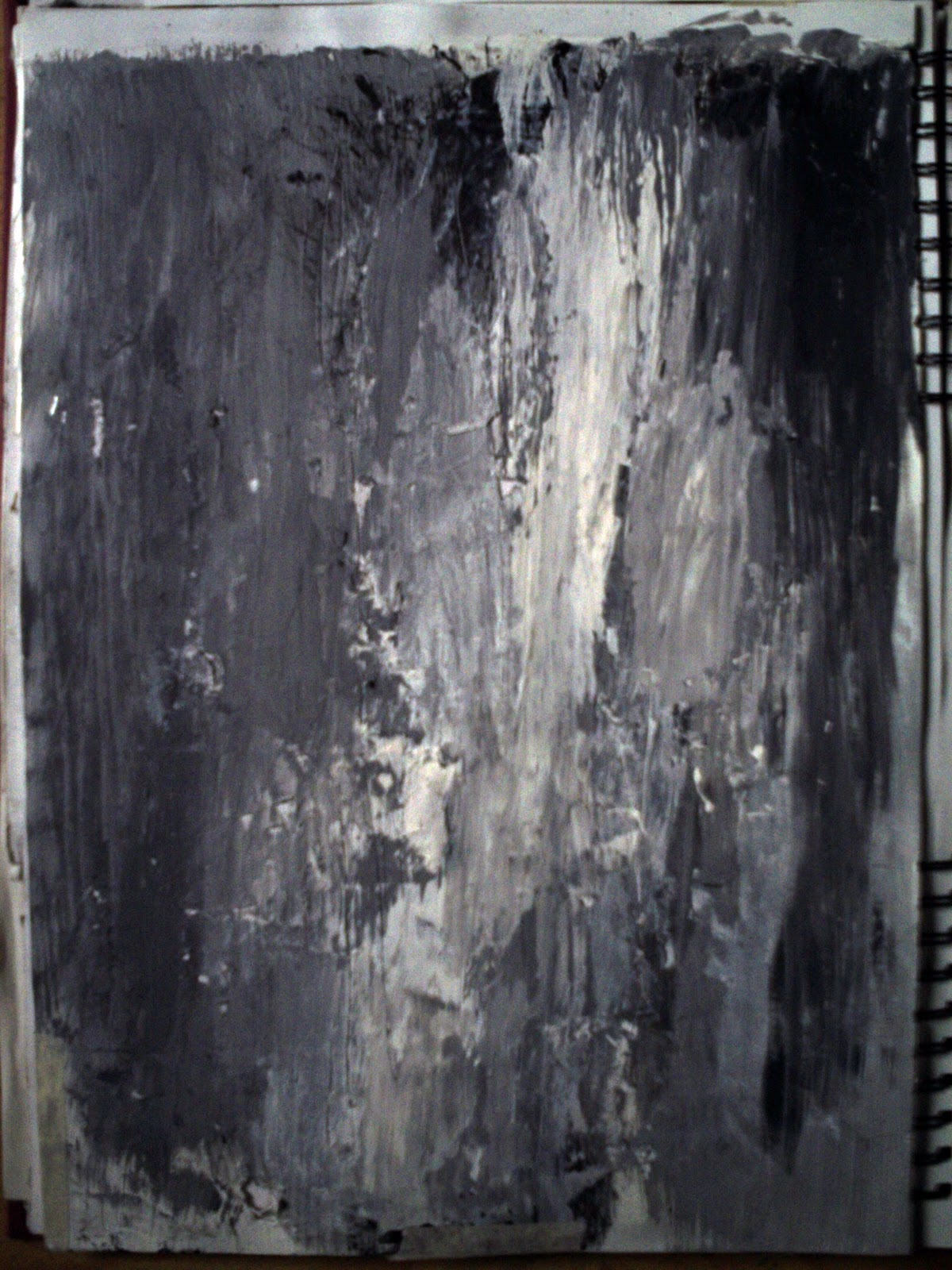
(What layering emulsion paints - white, black, greys - might look like on paper)


(Looking at the compostion and the effectiveness of the finished image)

Opening a Door

So the first thing I needed to do was to get out of my sketchbook and try something new.  I had never worked large scale before and I figured that the freedom of movement would be a nice change.

Deciding that I would take inspiration from my doorway drawings from my previous posts and the photographs of an old, abandoned building - I rolled out a large sheet of paper, about the 3/4 the height of the wall; went down to the technican's and got two large containers of emulsion paint (both black and white) and just went for it:


I didn't just use the emulsion paint, I tried to get the most out of it and build up as much texture I could using only the paper.  This meant that I was continuously layering the paint (white on black, black on grey, etc) and then scraping away the surface when the paint was dry (and sometimes wet - creating hardened lumps of paint).  I also tried tearing into the surface of the paper a little bit, without tearing holes into the piece.


Once I had that much done, I started to add elements of chalk pastels and charcoal over areas of paint and also used plaster to create a rough texture.

Progress Review

In my progress review I was told that was getting very distracted by trying to combine too many different elements/ideas into this progrect, and as a result I was unable to move past stage one.

Mike Fox and Grainne liked my idea about doors and doorways, and said that this was a rich area to look into, and I agreed that I liked that part the most too.

Another criticism was that I was working too small in my sketchbook and that if I was going to focus on doors, I needed to make an impact by working on a larger scale and experimenting a bit more.

In a way, this progress review was a total eye-opener for me and it gave me the incentive to work harder and just stick with one simple idea - letting it grow and develop naturally as I continue with my project.